Holiday Checklist

from Where the Butterflies Go

This Christmas, I am telling my inner Supermom to leave the building.

In the pre-Christmas chaos, I will remember to breathe while juggling the buying flying shopping shipping put-it-on-plastic happy hoopla pot luck and good luck trying to squeeze into last year’s little black dress.

Multi-tasking to the point of burn out will no longer be my middle name. I will not apologize or feel inferior if the cards are late or the presents aren’t perfectly gift-wrapped or the kids look like baboons in the family photo.

This Christmas, I won’t trip over my words when I start to say Merry Christmas to someone celebrating Hanukkah. Screw political correctness. This year I will remember what’s truly important: opening a door for a senior, giving food and clothes to the homeless, teaching the children it’s not all about that guy in the red suit.

This Christmas I will put on John and Yoko’s Happy Christmas (War Is Over)—and listen.

No. Really, truly listen.

Another year over, and what have I done? …And so happy Christmas, for black and for white, for the yellow and red ones, let’s stop all the fight.

This Christmas, I will be still. Between the turkey and the silly paper hats; between the wine and the goodnight kisses, I will find my true North star, make a wish for the world and count my blessings—every one.

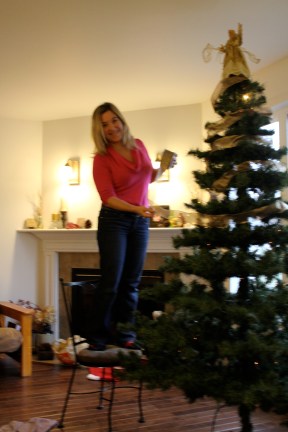
Stop and smell the...Christmas tree! Happy holidays and thanks so much for reading. xx
Stop and smell the…Christmas tree! Happy holidays and thanks so much for reading. xx

Review: Heather Grace Stewart’s Carry On Dancing (Winter Goose Publishing, 2012)

In the introduction to her latest book, Canadian poet Heather Grace Stewart describes what follows as ‘my small adventure’. In many ways, that’s a fair enough opening gambit. As she’s shown in Leap and Where The Butterflies Go, Heather is an accomplished and supple lyricist of the everyday and of the small miracles and telling moments which interrupt its routines (that some of these moments are also recorded in the poet’s own photographs is a bonus).

In this new collection, ‘Bookmarks’ is a finely honed example: a guitar sitting against a wall becomes ‘a bright reminder of/easier days’, but this souvenir of a personal belle époque is set against ordinary household chores – leaves being raked up outdoors, ‘the laundry,/left to fold’ – before the mood shifts and, outside, the sound of ‘laughter is the song/that fills/our sunlit yard.’ It’s a poem of only seventeen short lines, but it unpacks its momentary domestic occasion with the simplicity, precision and resonances of a pointillist interior. Similarly, ‘No Matter’ rises from its kitchen occasion to a dance ‘through the rainstorms/in this beautiful mess of a home’; while ‘Marilyn’ plays out a ‘little silly’ fantasy between ‘her Knight with Shining Briefcase’ coming home from work and ‘his spaghetti-stained/pinup girl gone wrong’ amongst ‘overpriced groceries, bills long overdue’ and ‘dinner thawing like their days’.

However, as the declaration of independence in opening poem ‘Enough’ puts it, ‘I am not my Facebook, my blog, or any of my Tweets,/I am not my purse, my shoes or my unmade bed’, and Heather’s palette extends way beyond these well-wrought vignettes. For a start, many of these poems are themselves shadowed by darker thoughts and suggestions, an often unspecified ‘dark matter’ – as in ‘I Melt’ with its plea to ‘let’s hold onto this picture’; in ‘On Days Like This’ with its admission ‘Sometimes I hold on/too tight’; or, more openly, in the first couplet of the William Carlos Williams-echoing ‘Maybe It’s Your Love’: ‘Maybe it’s your love/and all this death around us.’ Death haunts other poems, too – poignantly in poems about her daughter like ‘She Drew Me a Sky’ and ‘The Present’, and in the beautifully simple aubade and love poem which ends – and in many ways draws together – the themes of the whole collection, ‘Longer’:

just beneath

our breathing,

the humming fridge,

morning traffic –

The dead, they whisper:

No work that will not wait

till tomorrow.

Perhaps more so even than her previous collections, however, Carry On Dancing expands into poetry which addresses issues ranging from bullying (‘Words’) to gun law (‘Guns’: ‘the laughable laws/the ones that get made/and unmade/like an antique bed’) and war (‘Unrest’), whilst also demonstrating both Heather’s playful wit – ‘Kindlus Interruptus’, ‘Twaiku’ and a number of snappy ‘he said/she said’ dialogue poems – and fashioning of longer, more overtly performance-y style humorous and/or satirical pieces like ‘Boobies’ and ‘Should I Ever Become THAT Poet’.

All told, in fact, Carry On Dancing reveals Heather to be a poet who has very much come into her stride, leaving images and moments to speak (more than) themselves, but also confidently deploying a repertoire of styles and forms, from haiku and sometimes acerbic, sometimes aphoristic apercus to polished lyric, and deftly building ambiguities and embedded puns into the most seemingly direct turns of phrase: ‘with wired words they will write/my legacy, and get it wrong’; ‘she said yes,/no hesitation’. Perhaps Carry On Dancing doesn’t represent quite such a small adventure after all. (Tom Phillips)

Heather Grace Stewart & Carry On Dancing, March 2012


Don’t Leap!

This is about the only time I’d ever say that–as the author of a book titled, ‘Leap,’ I’d say I’m a pretty big fan of jumping in and going for it. But “Don’t Leap!” is definitely the appropriate title for the latest entry in my “By Leaps and Bounds” Photo Contest. This photo was taken by Tony Jurado on May 6, 2010, from the observation deck on the 86th floor of the Empire State Building in New York City, NY, USA. You can vote for this and other photos in the contest on my Facebook Author Page, and enter your own photo by following the rules in my previous blog post “By Leaps and Bounds Photo Contest”. Keep on leaping, everyone–I can’t wait to see what else you come up with for this contest!
Don't Leap!

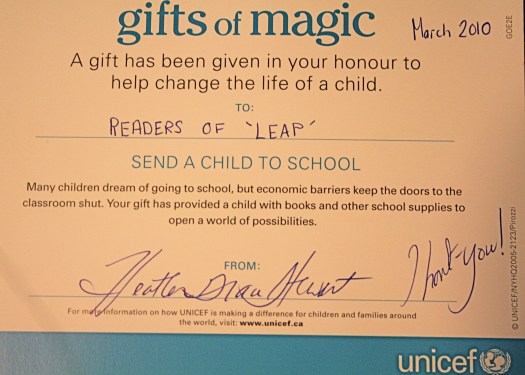
We Sent A Child To School!

Thank you, dear readers. Through sales of ‘Leap‘ in March 2010 alone (its first month out there in the world), I was able to donate to Unicef’s Gift of Education program, and we sent another child to school. But so much more could be accomplished, and it doesn’t take much. Please share with others your love of the books “Where the Butterflies Go” and “Leap.” Together, let’s send many more children to school. As my daughter said when she first started walking: Go, Go, Go!
Best wishes always, Heather

‘Leap’ by Heather Grace Stewart “engages, entertains, enlivens.”

‘Leap by Heather Grace Stewart (ISBN 978-0-557-29619-4)

Review by UK Poet Tom Phillips (Various Artists)

Following on from 2008’s Where the Butterflies Go and to some extent picking up some of the threads and moods from that collection (and, indeed, the odd poem, such as the elegantly fragile ‘Forecast’, itself now cast in a new light by one of the poet’s own photographs), Heather Grace Stewart’s Leap contains poems which are simultaneously sparer, richer and more diverse. Here, again, the essential drama is between the ordinary daily routine, when ‘there are/deadlines to meet,/bills to pay,/diapers to change’ (‘Coping’), and the extraordinary ‘other’ which both haunts and tantalises, the poetry finding its occasion in the unexpected emergence of the latter in seemingly simply everyday situations. In ‘Offline’, for instance, an ice storm ‘slowed us/for a few short hours’ but also keeps back the world and its routines so a couple can talk and listen ‘like it mattered/like hearing our own eulogies//and the minutes melted into hours’, while in ‘Progress’ a woman caught up – and dissatisfied – in the hurly-burly of instant, demanding, virtual communication ‘texts and types/Tweets and Skypes//then sleeps outside/where stars and/fireflies decorate the/infinite darkness.’ Tellingly, perhaps, ‘coming up for air’ is one of the phrases which echo from one poem to another: the moments isolated in the poems, whether they be a chance encounter (‘Paths’) or a parachute drop (‘The sun-filled sky says, “Brilliant!”/while the wind whispers, “Fool!”’), become restorative acts.
That this should seem such a strong theme in the book is, perhaps, at least partly down to the inclusion of Grace Stewart’s photographs. These, too, by definition, ‘capture’ the moment, their clear, sharp aesthetic providing, not mere illustration as such, but a visual commentary, a heightening of atmosphere, as in the shot of a barn beneath an immense expanse of sky cut only by a single jetstream or the layers of fading blue, like a Rothko painting, in a picture of a lake and landing stage. Photographs and poems don’t always make the happiest of bedfellows, the one making the other too explicit, narrowing down rather than opening up potential meanings, but here the A4 format gives the images plenty of room and they enrich rather than detract from the experience of reading.
All of which, perhaps, is to overlook other crucial aspects of Grace Stewart’s writing: its directness and its humour. As well as the poems which are, as it were, attending to transcendence, there are those which dryly, drolly comment on the foibles of the internet age –in particular, Facebook and Twitter addiction, and, as the title of one piece has it, that ‘New Poetic Genre: The Status Update’. ‘If he were living today/would Shakespeare/use Facebook?’ muses Grace Stewart, postulating such poetic ‘updates’ as ‘Will Shakespeare can see a dagger before him’, while ‘one smart old man’, a sort of virtual Humbert Humbert, transforms himself into the ‘charming and wise’, double-d-cupped ‘Lolita’, and, in the self-explanatory short, ‘140 characters of less’, the whole Tweetocracy collapses into a satirical slogan the marketing department almost certainly won’t be plagiarising: ‘I’m bored, I’m bitter, I’m on Twitter’. On the other hand, too, this more direct, more performative style leads towards other, more serious themes, such as post-9/11 anxiety and the detachment of the almost mythical political world from the one which the rest of us inhabit – ‘one hand’, after all, really can’t ‘hold the weight/of the world.’
Ultimately, in fact, you could say that this collection embodies a similar recognition: poetry, too, can’t hold the weight of the world but it can, as it does in these accomplished but unforced pieces, engage, entertain and enliven. (Tom Phillips, Various Artists)


Leap is available here