An Interview with Heather Grace Stewart


Leap, from the author of Where the Butterflies Go, is available for purchase at Lulu.com and Amazon stores worldwide.
It’s also available on Kindle, Kobo, iBooks, and where all fine ebooks are sold. You can also order an autographed copy via Paypal. Contact the author at writer@hgrace.com. Half the proceeds from sales go to Hearts for Change – an Educational Project for orphaned children in Kenya.


Here’s an interview with the author from 2010:

Questions for a Poet, As Put to Seamus Heaney

Q: Some years ago, Seamus Heaney told an English journalist: “My notion was always that, if the poems were good, they would force their way through.” Is this now your experience?

HGS: Absolutely. Sometimes it comes through in a matter of minutes; other times, I write down a few lines, and the rest follows maybe a day or a few weeks later. But if it’s good, it all ends up on the page…and then typed into a document in my “Poetry in the works” file on my computer, and then, if I still like it after I’ve lived with it a couple weeks, I put it into a “Poetry to publish” file.

Q: Over the years, Heaney often quoted Keats’s observation, “If poetry comes not as naturally as leaves to a tree, it had better not come at all.” Is that just a young poet’s perspective?

HGS: I think so. It doesn’t always come naturally to me. Sometimes I just need to sit down and force myself to write. Stop listening to the whining voice; shut it out, and just “do it.”

Q: Does this mean that a poem essentially begins for you when you find a form?

HGS: A poem essentially begins for me when I’ve found my voice for it; the form takes shape with the voice.

Q: Is there a poetry time of day and a prose time of day?

HGS: Used to be I used my early mornings for poetry and at sunset, and prose anytime, but now that I am a mother, it’s when I have a notepad, pen, and that spare minute when I’m not being asked to wipe a bum or put Barbie’s head back on.

Q: I remember Anne Yeats saying that her father mumbled to himself when he started to write. Would the Stewart household know that a poem was coming on?

HGS: In my household my hubby can usually tell a poem (for kids or adults) is being born if he comes home at 6:30 p.m. and DD is beside me doing a puzzle; a grilled cheese or rice is burning on the stove, and I’m soaking wet; just out of the shower in a towel with a focused look on my face, typing at the computer, “Just a minute, honey I have this idea…” And he’s so cool about that. He’s used to me by now. Now my daughter’s getting in on it, too. She looks at my face sometimes and says, “Mommy, what? Do you have an idea? Tell me, tell me, what is it? ” I try hard to be in the moment with her as often as I can, but the kid is smart, she’s onto me…so I usually end up spilling, because I don’t like to talk down to her, and sometimes, just by explaining it to her, she helps me better formulate the idea. Just wait, you guys are going to love our kids poem, ‘Cats Can’t Cook!’

Q: Do you ever feel burdened by the sheer amount of work you know it will require to do justice to a particular inspiration?

HGS: All the time. All the time. Right now, I’m trying to write a poem that’s going to do justice to this amazing group of people I’ve met online, and become close to over a year and a bit. Some might guffaw that you can make special friendships online. I beg to differ. I don’t know how I’m going to write something that truly speaks to this experience I’ve had. I think maybe they’ll help me somehow, because a lot of them are writers…actually, I’ve dedicated LEAP in part to them.

Q: How can you tell a poem is finished?

When it stops shouting at me. 😉

Q: Do you keep a notebook of phrases and images for later use?

HGS: I have several notebooks, with penned poems/ ideas to type out later, and my images are saved on the computer by date.

Q: Does the poem come more quickly if there is a form? Would you be offended to be called a formalist?

HGS: I don’t think anyone would call me a formalist, but I definitely use techniques. Just not formally. Okay, seriously now, I’ve written haiku, tanka,
and Villanelles, using proper form. I just don’t like being weighed down by form. As Frank sang, I’ll do it my way 😉

Q: Do you have a preference for pararhymes and half rhymes over full rhymes?

HGS: I only use rhyme when it will only come to me that way, and even then, I hesitate to use it. I have to think about it first. I ask myself, is this form going to help the message or hinder it?

Q: Are you a poet for whom the sound the words make is crucial?

HGS: It’s all about sound for me. I love alliteration. Sometimes a poem starts out with words that sound great together; they just come to me and I have to write them down. For instance, I was walking to a Queen’s University class at 8 a.m. one rainy spring day in Kingston, and couldn’t get this line out of my head: ‘These are the days, quickly melting away,” (from the poem EQUINOX). The poem took off from there.

Q: Would you accept Eliot’s contention that the subject matter is simply a device to keep the reader distracted while the poem performs its real work subliminally?

HGS: To some extent. But I don’t do it on purpose. It must be subliminal. 😉

Q: What role does humor play in your poetry?

HGS: I don’t try to be funny. I don’t try to be anything. I just write the way I think, and I think people find my honesty refreshing and humorous.

Q: What are your thoughts about accessibility and obscurity in poetry?

HGS: Accessibility is probably my trademark: something I’m proud of and at the same time it’s my tragic flaw, if you will, because I’m so accessible, many journals wouldn’t be interested. I’ve managed to get several respected online journals interested, and printed ones in the UK, and even a Canadian textbook company sought me out. I’ve been published in international anthologies, including a very special one memorializing 911–Babylon Burning, edited by the great Canadian poet Todd Swift–and in a few print journals in Canada, but not the most “elite” ones–the ones that have been around almost 100 years. I’ve kind of given up trying because I don’t think it’s that important to me any more. I want to touch real people’s lives; not just the academics. I want to write something that might comfort a stay-at-home mom or a couple struggling with their love/ marriage or a depressed person looking for a glimmer of hope in a fast-paced world. I think the people I’m trying to reach are more likely to happen upon my poetry on the Net, not so much in the special collections rooms of their libraries. I know that people can understand my poetry without having to go look in some reference book (except for the odd references I make to items in the news, and even then I try not to be obscure) and that’s quite odd. But I can’t change the way I write. I guess I’m destined to be a Fridge Poet – the one that makes it to everyone’s fridge beside their kids’ finger paintings. And at the same time, to help a few children in third-world countries get the education they wouldn’t otherwise get. That’s just fine with me.

Q: And the avant-garde?

HGS: I’d love to be avant-garde. I’d love to be Avant anything. Ahead by a Century. That’s cool. I think some of my poems are there (for instance, my collection Leap features the concept of the Status Update as poetry), others, not so much, and I guess we’ll see which ones stand the test of time in 100 years. Well, no, unless I live to be 137, I guess I won’t see that. But whether they’re set in a classic or innovative style, as long as my words can touch a few people’s hearts along the way…for me, that’s really all that matters.

Thanks for reading! —Heather Grace Stewart
Another Five Star Review for Three Spaces!

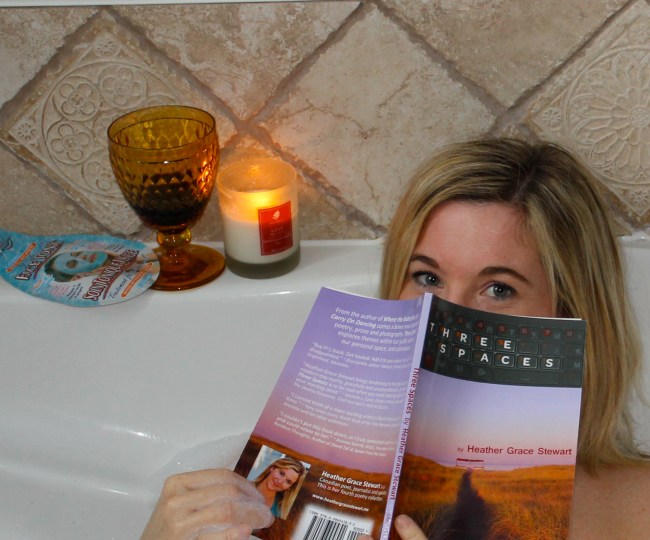
THREE SPACES
5.0 out of 5 stars

A self-contained trilogy of insight in microcosm and macro-wisdom January 16, 2014
By Carl J Dubois

Format:Paperback|Amazon Verified Purchase

The concept of “Three Spaces” is more genius than appears at first glance. Public Space and Personal Space are prelude and context for Cyberspace, and they set up beautifully the expression of the mixed emotions inspired by the new connectivity we find ourselves navigating in this changing world.

“Dances With My Daughter,” in the Personal Space section, reveals — perhaps more than anywhere else — the poet, the woman, the mother, the wife, the person — the author and thinker coming to terms with all of life’s demands, and the juggling act required by them, but mostly the liver of life who knows where the real stuff resides, and why we juggle.

It is instructive, accessible reflection from someone who finds the time to observe in a briefly detached way before rushing back into all of life’s entanglements, commitments and momentum. So wonderful too how often it feels communal, as if she is expressing what we feel but struggle to say.

Open it to any page and enjoy the simple wisdom and honest revelations of self from a soul whose writing feels like her balancing act — beauty found in the spaces between all of our appointments, and like gifts rather than some obligation we have to read it so we can move on to the next thing on our list. You will want to keep it close by, to see what gifts it reveals next time.

Image

Art Inspires Art

One of the reasons I like sharing part of my world with you on this blog is to inspire others —especially those of you who don’t think you have a creative bone in your body—to try their hand at one or more forms of art. I’ve always loved writing, drawing, painting and photography, but I’m not equally good in each discipline. Each art form relaxes me in its own way, and gets my creative juices flowing.

Do you ever tire of one art and feel like your well has run dry? That’s the best time to take a break and try another art form altogether.

In my case, I needed a break from plotting and writing my novel. My 8-year-old daughter wanted to try acrylic painting, and while I wasn’t sure I could teach her much, I decided to try.

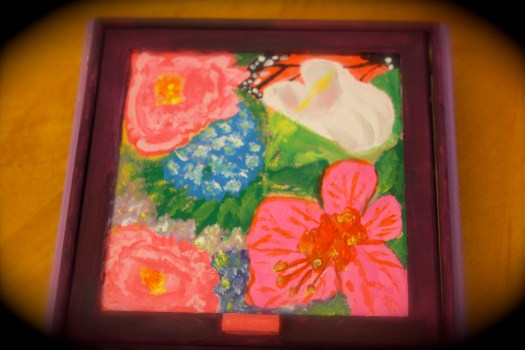
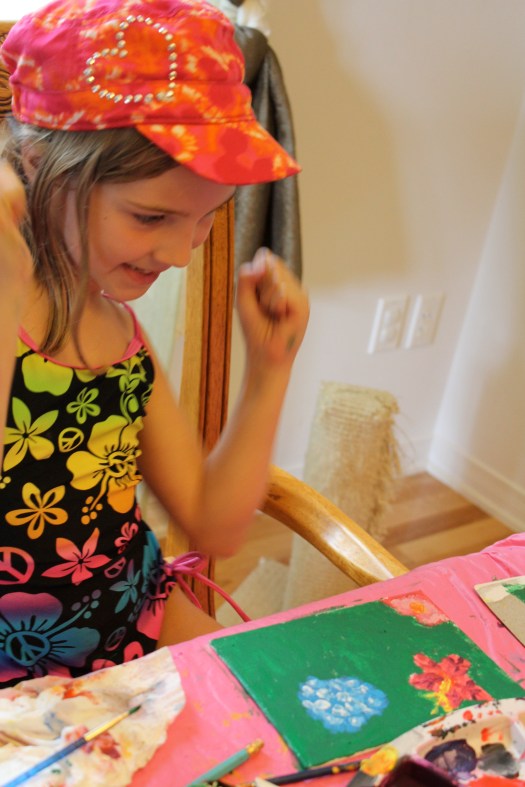
She painted a small treasure box with her name on it, and I tried to paint a garden on a wooden jewellery box. Next, she tried a Pegasus with magical pink clouds behind it. Then she tried to do exactly what I’d done: a hibiscus and hydrangea. And she wanted me to talk her through it!

What a challenge for me to try to explain how I paint. I’ve never explained it before. It was exercising a new artistic muscle for me, just to explain how I paint petals and light. I was also afraid to teach her the ‘wrong’ way, since I’m no expert!  But look at her face when she got her hibiscus the way she wanted. Such joy!

I’ve learned today that taking a break from an artistic project doesn’t mean you have to stop being creative altogether. I’ve also learned how working together as artists can be energizing and revitalizing.

I’m feeling refreshed and ready to get back to writing that novel tomorrow!

IMG_3098 IMG_3102_2 IMG_3104

Give Yourself Some Breathing Space

IMG_9235_2

Hey there!
Just a thank you to all you Kindle readers for picking up Three Spaces in THREE countries!
I am thrilled that it has been sold in the Canadian Kindle store (Amazon.ca), the US store (Amazon.com), and the UK (Amazon.co.uk)  It has ‘charted’ as #1 in Kindle Books>Canadian Poetry on Amazon.ca and also hit #7 in Bestselling Canadian Poetry Books!

Yesterday was a very good day. Three Spaces was on best-selling charts in all three countries! #82 on Amazon.com in Bestselling Poetry; #84 on Amazon.co.uk in Bestselling Poetry Books (just above Milton- wow- made me laugh!) ; #7 in Bestselling Canadian Poetry Books on Amazon.ca.

While I try to take rankings lightly, as it doesn’t necessarily mean I’m selling a ton of books but just out-selling others in that category, I do try to compete with myself every time I bring out a new book.

I’m thrilled to say that this is my best-selling poetry ebook yet! And the first one to hit three bestselling Amazon charts at once!

Three Spaces will be out on Kobo, iBooks, Nook Books, Sony Reader and more soon.

Please do tell your friends about Three Spaces (share this post!). It’s got prose as well as poetry this time, and full colour photography for those nifty colour e-readers.

Thanks again so much for buying & sharing!

Heather

Making Space for Accessible Poetry

February 15, 2013

Canadian Poet Heather Grace Stewart launches her fourth poetry collection, Three Spaces

Three Spaces is a ‘brave new collection’ of poetry, prose and photography from Amazon and iBooks Canada bestselling-poet and journalist Heather Grace Stewart.  It examines themes within three spaces of our society: public space, personal space, and cyberspace.
“I wanted to put out a collection that was a reflection of our society today, of how we’re trying to balance our  public lives with our lives in cyberspace, all while trying to maintain some privacy in our personal lives,’ Heather explains.

“There are dark and intense poems that start this collection, but then I move into tender, humorous poetry and prose to lighten the mood, and colourful images that can provide space for introspection,” Heather explains. “As always, I try to give my poetry substance, but make it accessible. I don’t want my readers scratching their heads or pulling their hair out after reading one of my poems! I want them to relate in some way. I’d like for them to walk away from the experience of reading this book feeling moved, energized and entertained.”

Early reviewers describe Three Spaces as ‘inspiring’ ‘heartfelt,’ ‘professional’ and ‘modern.’ Best-selling Author Elisa Lorello (Faking It, Adulation) writes,

“Buy this book. Get hooked. Add it to your space. You won’t be disappointed.”

Three Spaces is available now in Kindle Stores Worldwide, including Canada, USA & India, the UK, Germany, and many other countries, as well as on Kobo, iBooks, Nook, Sony Reader, and many other epub readers.

It will be available in print on Amazon and in bookstores in April, IF there is enough initial interest (at least 100 requests ) to warrant the production costs.

Heather will appear at Chapters Pointe Claire, Quebec on April 14th to celebrate National Poetry Month and to read from Carry On Dancing and a Kobo version of Three Spaces on her Kobo for IPad app.

Heather’s poems have been published in Canadian literary journals, newspapers and magazines, nation-wide school textbooks, international print anthologies, online journals, and in the British small presses. She was awarded Queen’s University’s McIlquham Foundation Prize in English Poetry (1995) and the UK journal Various Artists’ Poet’s Poet Award in 2008 and 2012.

Her third collection of poetry and photos, Carry On Dancing (Winter Goose Publishing, 2012)  hit #1 on Amazon Canada’s Bestselling Poetry list in April 2012, and stayed there for several weeks. It’s now topping the Canadian Kindle Bestselling Poetry charts along with Where the Butterflies Go.

Her second collection of poetry and photos, Leap (Graceful Publications, 2010), has been described as a “lovely lilt of language,” and, “a must for new and already hooked fans,” by reviewers. Where the Butterflies Go (Graceful Publications, 2008), was reviewed as “whirlwind poetry that never hesitates…always delightful and rarely what you expect. We need poetry like this.”

Heather is also a children’s poet, and enjoys screenwriting. The Groovy Granny (2012 Kindle version; Special Audio Version on iBooks) and The Friends I’ve Never Met (Romantic Comedy screenplay, 2012) are her best-selling Kindle books.

Her photographs have appeared in Equinox and National Geographic Traveler among others, and on the cover of over a dozen poetry books.

Born in Ottawa, Canada, she lives with her husband and daughter near Montreal. In her free time, she loves to take photos, scrapbook, cartoon, inline skate, dance like nobody’s watching, and eat Swedish Berries — usually not all at the same time.

Three Spaces