
In the introduction to her latest book, Canadian poet Heather Grace Stewart describes what follows as ‘my small adventure’. In many ways, that’s a fair enough opening gambit. As she’s shown in Leap and Where The Butterflies Go, Heather is an accomplished and supple lyricist of the everyday and of the small miracles and telling moments which interrupt its routines (that some of these moments are also recorded in the poet’s own photographs is a bonus).
In this new collection, ‘Bookmarks’ is a finely honed example: a guitar sitting against a wall becomes ‘a bright reminder of/easier days’, but this souvenir of a personal belle époque is set against ordinary household chores – leaves being raked up outdoors, ‘the laundry,/left to fold’ – before the mood shifts and, outside, the sound of ‘laughter is the song/that fills/our sunlit yard.’ It’s a poem of only seventeen short lines, but it unpacks its momentary domestic occasion with the simplicity, precision and resonances of a pointillist interior. Similarly, ‘No Matter’ rises from its kitchen occasion to a dance ‘through the rainstorms/in this beautiful mess of a home’; while ‘Marilyn’ plays out a ‘little silly’ fantasy between ‘her Knight with Shining Briefcase’ coming home from work and ‘his spaghetti-stained/pinup girl gone wrong’ amongst ‘overpriced groceries, bills long overdue’ and ‘dinner thawing like their days’.
However, as the declaration of independence in opening poem ‘Enough’ puts it, ‘I am not my Facebook, my blog, or any of my Tweets,/I am not my purse, my shoes or my unmade bed’, and Heather’s palette extends way beyond these well-wrought vignettes. For a start, many of these poems are themselves shadowed by darker thoughts and suggestions, an often unspecified ‘dark matter’ – as in ‘I Melt’ with its plea to ‘let’s hold onto this picture’; in ‘On Days Like This’ with its admission ‘Sometimes I hold on/too tight’; or, more openly, in the first couplet of the William Carlos Williams-echoing ‘Maybe It’s Your Love’: ‘Maybe it’s your love/and all this death around us.’ Death haunts other poems, too – poignantly in poems about her daughter like ‘She Drew Me a Sky’ and ‘The Present’, and in the beautifully simple aubade and love poem which ends – and in many ways draws together – the themes of the whole collection, ‘Longer’:
just beneath
our breathing,
the humming fridge,
morning traffic –
The dead, they whisper:
No work that will not wait
till tomorrow.
Perhaps more so even than her previous collections, however, Carry On Dancing expands into poetry which addresses issues ranging from bullying (‘Words’) to gun law (‘Guns’: ‘the laughable laws/the ones that get made/and unmade/like an antique bed’) and war (‘Unrest’), whilst also demonstrating both Heather’s playful wit – ‘Kindlus Interruptus’, ‘Twaiku’ and a number of snappy ‘he said/she said’ dialogue poems – and fashioning of longer, more overtly performance-y style humorous and/or satirical pieces like ‘Boobies’ and ‘Should I Ever Become THAT Poet’.
All told, in fact, Carry On Dancing reveals Heather to be a poet who has very much come into her stride, leaving images and moments to speak (more than) themselves, but also confidently deploying a repertoire of styles and forms, from haiku and sometimes acerbic, sometimes aphoristic apercus to polished lyric, and deftly building ambiguities and embedded puns into the most seemingly direct turns of phrase: ‘with wired words they will write/my legacy, and get it wrong’; ‘she said yes,/no hesitation’. Perhaps Carry On Dancing doesn’t represent quite such a small adventure after all. (Tom Phillips)

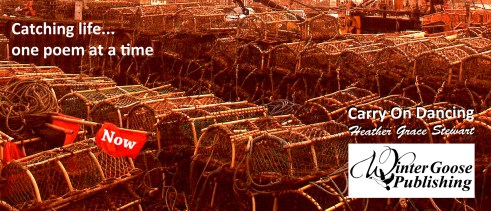



 Heather Grace Stewart