
Happy Friday everyone! I’m pleased to announce I’m reviving my Interview with a Poet series! I’ll try to feature one new poet here every week. Please let me know if you’d like to be featured by contacting me in the comments section below, or drop me a line via email.
My first featured poet of 2014 is Alexis Spencer-Byers.
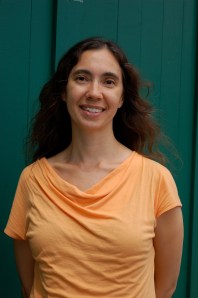
Alexis Spencer-Byers was raised in San Francisco; completed a degree in English at Amherst College in Massachusetts; engaged in various types of community development work in Jackson, Mississippi; and currently lives in Los Angeles, where she works as a church administrator and freelance copy-editor. While in Jackson, she co-founded Koinonia Coffee House, an inner-city café and community gathering place.
I haven’t met Alexis in person yet, but we’ve exchanged a lot of great emails and discussion board posts. We met back in early 2009 on Aaron Sorkin’s Screenwriting discussion board on Facebook, and have kept in touch ever since. I love her poetry, and am so thrilled that I can feature her here today.
Her recent poetry collection is titled Another’s Treasure.

Here’s our interview:
When did you start writing, and why? What keeps you at it today?
I started writing in the fourth grade, when my teacher, Mr. Kritikakos, gave the class a short story assignment. We were supposed to imagine that a famous person came to have lunch with us and write about the experience. I chose the royal family of England as my lunch guests—speculating that since Princess Diana and I shared a last name, we were actually distant cousins. This assignment introduced me to the joy of exploring possibilities beyond what I had experienced in my day-to-day life.
Later, as I continued to write stories, novels (none published and really all quite bad), and eventually poems, I discovered how wonderful writing was, not just as a way to imagine alternate realities, but as a means of making sense of actual realities. This is its main value to me today—it helps me to process the things I experience, observe, fear, wonder about, etc. As I am not at all talented in more visual arenas (drawing, painting, interior design, etc.), it is also my one shot at contributing something of beauty to the small corner of the world which I inhabit.
Tell us a bit more about yourself? What do you do for a living, what are your hobbies, and when/where do you write?
My vocational life is a complete hodge-podge at this point. I work part-time as a church administrator and also freelance as a writer/editor/proofreader. On a volunteer basis, I have begun serving with a few organizations in the Los Angeles area that work with incarcerated and formerly incarcerated youth and young adults. Some of these organizations are specifically writing-focused (Street Poets and InsideOUT Writers), and it’s a real joy to see writing provide a means of creative expression, emotional release, and self validation to young people who may never have thought of their voices and stories as having value.
Does watching baseball count as a hobby? Because that is how most of my discretionary time has been spent the last few years. I also enjoy various types of puzzles (jigsaw, crossword, etc.).
I mostly write at home (often after jumping quickly out of the shower, because something has suddenly occurred to me as I washed my hair), in the car (I promise I pull over before starting to scribble!), or at Street Poets’ weekly Seeking Peace poetry circles.
Tell us about writing Another’s Treasure. What was the hardest part? The most rewarding part?
The poems in Another’s Treasure were written over the course of nearly 10 years, but I didn’t start thinking about assembling them into a collection until about 3 years ago. I put together a manuscript over the next year or so, and then sought feedback from a few family members and fellow writers. One thought that came back was that the California section did not feel as finished as the Mississippi section did. (At that point, I had been back in California for just a couple of years, after living in Mississippi for almost 15.) So one of the challenges was to do enough California living to have more things to say about it!
The greatest challenge for me, though, is that sending my words into the world leaves me feeling incredibly vulnerable. Sharing any writing is risky, but sharing work that is largely autobiographical and very personal makes me feel like so many parts of myself (including both my writing ability and my life choices) are on display and open to judgment. Of course, that ties in closely to the most rewarding part: having another person resonate with my experience or ideas. There is nothing quite like hearing someone say, “I’ve felt just like that. Thank you for putting it into words!”
Of course, this ties in closely to the most rewarding part: having another person resonate with my experience or ideas. There is nothing quite like hearing someone say, “I’ve felt just like that. Thank you for putting it into words!”
Can you share one poem from it here and explain a little about why you wrote it?
Speaking of vulnerability… The theme of Another’s Treasure is the idea that beauty can be found in (and art created from) the “scraps” we find in the world around us—whether those are literal bits of metal, paper, glass, etc. that we assemble into sculptures or mundane bits of life experience that we write about in a poetic way.
I had done a number of poems that explored this theme externally, but eventually I realized that I needed to be brave and do a little introspection. At the time, I had just quit a job that had seemed like a good way to get back into meaningful community development work (teaching at an inner-city after-school program) after spending a few years in my copy-editing cave, but which turned out not to be a great fit with my gifts and temperament. I had to wrestle with the fact that not only did I not have an illustrious vocational history, but I also did not have a clear sense of a career path ahead of me. As someone who has spent a lot of time chasing various (often somewhat outlandish) dreams, the idea of allowing my life to take shape around me and finding value/meaning in “small” things like once-a-week volunteer commitments, investing in individual relationships, and even writing poems rather than longer works like novels or screenplays was foreign and a bit unsettling.
I stagger into the quarry
limping under the oppressive weight
of a beautiful
but ill-fitting
burden.
As I tenderly relinquish
the latest in a series of boulders—
each lovelier than the last
and all smeared
with the sweat, blood and tears
extracted by the double-edged pick
of imperfect discernment
and hard labor—
joy at the release
mingles with the gnawing emptiness
that now rests
upon my ravaged shoulders.
As the anxiety mounts,
I frantically survey the field
searching for another massive stone
I might be fit to carry,
not yet seeing the exquisite mosaic
taking shape upon my back:
multi-colored remnants of rock
some smoothed by time,
others still bearing
jagged edges
all mementoes
of seasons past—
reminders of small successes
instructive failures
unexpected adventures
and opportunities
momentous occasions
both glad and grievous
and the richness of life shared with others
still learning to embrace
a yoke that is easy
and a burden that is light.
What’s the coolest place your poetry has taken you to? It could be a place, or an experience, or even a person/people you’ve met because of your poetry.
This is such a great question! While it’s a bit strange to call juvenile hall “cool,” I think that’s going to have to be my answer. For many years, I had been concerned about violence among young people and the high rates of juvenile incarceration in the U.S., but I hadn’t found a way to involve myself in work to address these issues. Then, shortly after moving to Los Angeles, I made the acquaintance of some folks who served with an organization that ministered to incarcerated youth. They told me that many of the young people they interacted with were interested in poetry (which seemed highly unlikely to me, but who was I to question their testimony?), and they suggested that I come visit one of the detention facilities with them. When I did so, I discovered that they were absolutely correct—for many of these youth, writing is a lifeline that helps them survive their time in detention and allows them to imagine a future different from what they’ve experienced previously. It has been my privilege and joy, over the last couple of years, to assist a few young people in compiling collections of their writing, and to encourage numerous others more generally to continue developing their talents and voices. I’ve also met a number of “alums” of various facilities/programs, and they are both powerful writers and amazing people.
Do you belong to a writing group? Are you part of the Twitter writing community or not? Can you talk about this a bit – do you find belonging to a writing community is helpful? Why or why not?
The closest thing I have to a writing group at this point is the Street Poets circle I attend. I find a great deal of value in this gathering, where writing is created and shared, both in terms of maintaining momentum in my own writing life and for the sake of being exposed to other styles of writing and presenting poetry. (Plus, I get to sit in a room with a bunch of truly inspiring folks!) I have not ventured into the Twitter universe yet. Frankly, the immediacy of it scares me a little bit. My style is to work something over and over before allowing it out in public, and that doesn’t necessarily seem compatible with the pace of online exchange. Perhaps this will be a growth step for me going forward…
Why do you think poetry survives, in this day and age of TV, video games, YOUTUBE, surfing…Why is it still alive and, some would say, thriving?
I think that as human beings, we long to connect and identify with other human beings. As I mentioned before, poetry is often very personal writing—a way of sharing our own experiences, emotions, questions, etc. There’s an intimacy to it that can make both writer and reader feel a little less alone in the world. Obviously, we can get some of this sense of connectedness—along with the entertainment—from video content as well, but maybe this is another pacing thing. We experience video at the speed at which someone else decided we should experience it (unless we take the trouble to slow it down). Poetry—written poetry, anyway—we can take in at our own pace and mull over until it’s had a chance to settle deep within us and work its healing/inspiration/affirmation/challenge/comfort/what-have-you.
Any projects in the works? Let us know!
No specific plans at this point, although there is a growing “Poetry Collection #3” folder on my computer. I had ideas, when I moved to Los Angeles, of trying my hand at screenwriting, but (for now, at least) that notion is on the back burner as I write in bite-sized pieces that fit well into my patchwork life and schedule.
Heather, thank you so much for this opportunity to introduce myself to your online community! (And for your wonderfully thought-provoking questions!) It’s such a pleasure and privilege to be a co-laborer with you in the work of creating poetry and making it available to those who might appreciate it and be encouraged by it. All the best to you and yours!
It’s been a pleasure, Alexis, and I am sure my readers will agree.
Another’s Treasure is available on Amazon and via Alexis’s website Alexis is offering a special pricing code HGS1411 so readers can get a discount there. Paperback orders for any addresses outside the USA can be placed via Amazon.



 Heather Grace Stewart