‘By Leaps and Bounds’ Photo Contest

I’d love to know more about my readers –where you live, where you’ve leapt, where you’ve leapt with ‘Leap’! Here’s hoping we all have
some fun with this three-month-long photo contest.

RULES, VOTING, RED WINE AND DARK CHOCOLATE

1) Take a photo of ‘Leap’ somewhere in your home, town, or city, or someplace special you’ve traveled to–it can be as close-up as against an old tree in your backyard, or as far-away as a wide-angle of Times Square, with ‘Leap’ somewhere on the sidewalk. We just need to be able to see the book ‘Leap,’ and you need to be creative. You don’t need to be in the photo, if you’re not comfortable with that, since all entries will be published here on my blog and on my Facebook Author Page too, however, you need to think outside the box with this. You need to Leap!

2) E-mail the photo to me at writer@hgrace.com, and include the place where it was taken and the photographer’s name, so I can give the photo a credit, and get the entrant’s name. If you don’t want to use your real name on the Net, give me a pseudonym to use as the credit, that’s fine. As long as I have your e-mail to contact you if you’re the winner, it’s great.

3) Visit here as often as you can to check out and discuss the competition! Then visit my Facebook Author Page to VOTE. Every thumbs-up on that Facebook Author Page is a vote. Every positive comment or a comment with simply the word ‘VOTE’ is another vote. You may vote on your own photo. You may comment on your own photo as many times as you want –however, your vote in the comments section only counts once. You can also convince all your friends and family to join my Author Page and vote on your photo, too. They can give it a thumbs up AND make a comment (or simply the word ‘VOTE’) and that counts as 2 votes. Everyone can vote on as many photos as they wish! I will not be allowed to vote on the photographs on Facebook but I might comment on some –any comments from me under the photos will not count as votes, however.

4) You may enter up to two photographs.

5) Contest begins Wednesday, April 28th and ends Sunday, August 1st at noon. The winner will be announced some time that week.

6) Should there be a tie in the peer-voting on Facebook, I have chosen three impartial judges who, together, will choose a winner.

7) The winner will receive a very fine bottle of red wine and boxes of dark chocolate, or, if they don’t drink wine, a cheesecake delivered to their door. (Yes, this can be done, some wonderful people have done it for me, and I’ll never forget it, and want to spread the joy!) Wine, chocolate, cake–these are the finer things in life, and I want to share them with my readers, as a way of thanking you for reading and sharing my poems.

HAVE FUN AND ENJOY THE JOURNEY!

Heather Grace Stewart- Canadian Poet (for Facebook Search)

FIRST ENTRY RECEIVED TODAY:

By Kimberly Jurado

Photo by Kimberly Jurado

“Leapt into one of my favorite village home decor shops today for some spring cleaning inspiration!” April 2010
“Poetry, Ahhhh!” –Not “Poetry, Arghhh!”

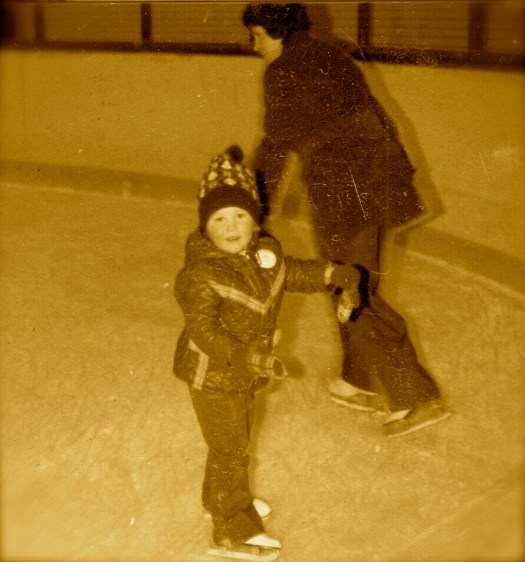
I’ve always been in love with poetry –but I loved words at a very young age, and my first experience being told to write a poem was a very positive one. My grade one teacher took us to the local arena, and when we returned, she asked us to write an “expressive limerick” about it. Then she explained that meant, “just write what you felt.” I wrote down, “I felt grand!” and away I went, titling the poem, “At the Arena.” Now an avid inline skater and a published poet, I’d like to think I was a natural at both skating and poetry (and I actually come up with a lot of my ideas for my poems while inline skating along the river.)

I also think the way poetry was first taught to me gave me such a positive experience that I didn’t ever fear it. All of my creative writing teachers let me be expressive. They didn’t force the rules. They taught me what I “should” do for a certain type of poem, but let me throw in my own style, too.

I’ve met (or cyber-met)  a lot of people from many walks of life while on this journey of writing and promoting my poetry. Many tell me they didn’t think they liked poetry–feared it, even– until they came across mine –and somehow, it spoke to them, and they realized it wasn’t as intimidating or as dull as they’d imagined.

Do you remember the first time you were told to write or recite a poem? Tell me about it. Were you intrigued, or scared out of your mind? Thinking about your experience, what do you think teachers and poets need to do to excite children about poetry, so that feeling stays with them for a lifetime?

I’ll be visiting some schools this year as part of the League of Canadian Poets’ ‘Poets in the Schools’ program, and I think your stories will help me keep the children engaged.

I’m asking this question on my Facebook Author Page too–come join in the discussion!

Heather Grace, 5, "At the Arena"

We Sent A Child To School!

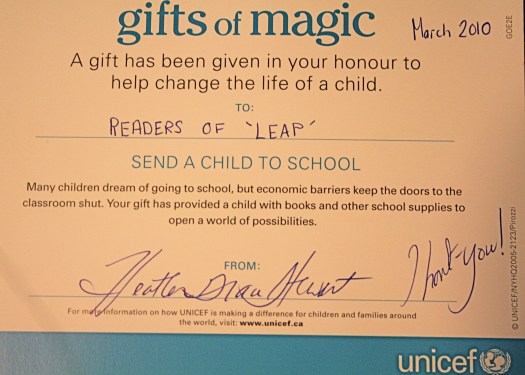
Thank you, dear readers. Through sales of ‘Leap‘ in March 2010 alone (its first month out there in the world), I was able to donate to Unicef’s Gift of Education program, and we sent another child to school. But so much more could be accomplished, and it doesn’t take much. Please share with others your love of the books “Where the Butterflies Go” and “Leap.” Together, let’s send many more children to school. As my daughter said when she first started walking: Go, Go, Go!
Best wishes always, Heather

‘Leap’ by Heather Grace Stewart “engages, entertains, enlivens.”

‘Leap by Heather Grace Stewart (ISBN 978-0-557-29619-4)

Review by UK Poet Tom Phillips (Various Artists)

Following on from 2008’s Where the Butterflies Go and to some extent picking up some of the threads and moods from that collection (and, indeed, the odd poem, such as the elegantly fragile ‘Forecast’, itself now cast in a new light by one of the poet’s own photographs), Heather Grace Stewart’s Leap contains poems which are simultaneously sparer, richer and more diverse. Here, again, the essential drama is between the ordinary daily routine, when ‘there are/deadlines to meet,/bills to pay,/diapers to change’ (‘Coping’), and the extraordinary ‘other’ which both haunts and tantalises, the poetry finding its occasion in the unexpected emergence of the latter in seemingly simply everyday situations. In ‘Offline’, for instance, an ice storm ‘slowed us/for a few short hours’ but also keeps back the world and its routines so a couple can talk and listen ‘like it mattered/like hearing our own eulogies//and the minutes melted into hours’, while in ‘Progress’ a woman caught up – and dissatisfied – in the hurly-burly of instant, demanding, virtual communication ‘texts and types/Tweets and Skypes//then sleeps outside/where stars and/fireflies decorate the/infinite darkness.’ Tellingly, perhaps, ‘coming up for air’ is one of the phrases which echo from one poem to another: the moments isolated in the poems, whether they be a chance encounter (‘Paths’) or a parachute drop (‘The sun-filled sky says, “Brilliant!”/while the wind whispers, “Fool!”’), become restorative acts.
That this should seem such a strong theme in the book is, perhaps, at least partly down to the inclusion of Grace Stewart’s photographs. These, too, by definition, ‘capture’ the moment, their clear, sharp aesthetic providing, not mere illustration as such, but a visual commentary, a heightening of atmosphere, as in the shot of a barn beneath an immense expanse of sky cut only by a single jetstream or the layers of fading blue, like a Rothko painting, in a picture of a lake and landing stage. Photographs and poems don’t always make the happiest of bedfellows, the one making the other too explicit, narrowing down rather than opening up potential meanings, but here the A4 format gives the images plenty of room and they enrich rather than detract from the experience of reading.
All of which, perhaps, is to overlook other crucial aspects of Grace Stewart’s writing: its directness and its humour. As well as the poems which are, as it were, attending to transcendence, there are those which dryly, drolly comment on the foibles of the internet age –in particular, Facebook and Twitter addiction, and, as the title of one piece has it, that ‘New Poetic Genre: The Status Update’. ‘If he were living today/would Shakespeare/use Facebook?’ muses Grace Stewart, postulating such poetic ‘updates’ as ‘Will Shakespeare can see a dagger before him’, while ‘one smart old man’, a sort of virtual Humbert Humbert, transforms himself into the ‘charming and wise’, double-d-cupped ‘Lolita’, and, in the self-explanatory short, ‘140 characters of less’, the whole Tweetocracy collapses into a satirical slogan the marketing department almost certainly won’t be plagiarising: ‘I’m bored, I’m bitter, I’m on Twitter’. On the other hand, too, this more direct, more performative style leads towards other, more serious themes, such as post-9/11 anxiety and the detachment of the almost mythical political world from the one which the rest of us inhabit – ‘one hand’, after all, really can’t ‘hold the weight/of the world.’
Ultimately, in fact, you could say that this collection embodies a similar recognition: poetry, too, can’t hold the weight of the world but it can, as it does in these accomplished but unforced pieces, engage, entertain and enliven. (Tom Phillips, Various Artists)


Leap is available here

“What Really Matters” — Review of Where the Butterflies Go

I just realized I’ve never posted a review of my poetry collection here on my blog.

It’s been almost a year since its release, and thanks to your kind interest, I’m very close to being able to make a third donation to third-world educational projects. What a thrill to have exceeded my goal like this.  Once a few more books are sold, I will donate to Unicef’s Gift of Education fund for the second time. So please consider the book as a possible Valentine’s or Mother’s Day gift, and tell your love or your Mom that half the proceeds  go to helping a child get an education they otherwise may never receive. I am happy to ship autographed copies if you contact me, just drop me a comment here so I know you’re interested.

UK poet Tom Phillips kindly took some time to review my collection when it was first launched. I would like to once again thank Tom, Tony Lewis-Jones, Kathryn McL. Collins, Sally Evans and everyone else who has dropped by and reviewed my book on the Lulu web site for taking the time to make such thoughtful critiques. What a year it’s been!

Where the Butterflies Go by Heather Grace Stewart
http://www.lulu.com/content/1506907

* * * * * * 6/6 stars

by Tom Phillips
Arranged under three broad headings – ‘Pain’, ‘Growth’, ‘Family’ – Heather Grace Stewart’s Where The Butterflies Go gets at the nub of what it means to try and live in a world which appears to be passing by at an ever more astonishing speed and where what’s pumped out through TV and computer screens seems startlingly at odds with both the realities of ordinary, day-to-day existence and our more humane impulses and aspirations. It is a book of illusion, disillusion and, as it were, re-illusion, an acknowledgment of loss and the discovery of fragile compensations. The great risk for poetry like this, of course, is that it can come across as rather naïve, the losses too easily overcome, the compensations too easily found. That’s certainly not the case here. Thanks to an exhilarating directness and a worked-for simplicity of language, not to mention a nicely self-deprecating sense of humour on occasion, this is a book full of sharply drawn images, honest poignancy and frank admissions.
Take ‘Golden Dreams’, with its refrain of ‘Durango gold, Durango gold’ alluding to the Colorado gold rush and, by implication, the consumerist dream. Here, on a home-improvements shopping trip, Grace Stewart is overwhelmed by a different sort of ‘rush’, one of harsher realities: “We choose ceramic tiles/content,/while war rages/over the ocean,” she writes, with a telling nod at childhood song (“My bonny lies over the ocean”, too), before admitting, with an almost brutal honesty: “We care, but still go about our lives.” Only, of course, she’s not letting herself off that lightly – there’s homelessness, a government dedicated to preserving the status quo… By the end all that’s left, it seems, are “dark clouds/across this Canadian sky”.
The causes of such disillusion seem legion. There are poems here about the 1989 Montreal massacre (when fourteen women were gunned down at the Ecole Polytechnique), child-soldiers in Sierra Leone, disenfranchised women in Iraq, 9/11, beggars, poverty, domestic violence, divorcing couples, and a child mown down by a speeding driver. In the ‘Pain’ section of the book in particular, it seems a bleak, broken and violent world where the only option appears to be to “forget about/the fragile parts/and go on surviving”.
Grace Stewart, though, doesn’t forget those “fragile parts” – love, empathy, hope – and refinding them occupies the remainder of the book. In many ways, this is about celebrating simple, mostly domestic pleasures – the sight of bulbs in the garden coming into flower, the “butterfly kisses” of an unborn child in the womb, that child’s first steps, an embrace, “the shelter of my lover’s arms”, “the melting days” at the end of winter – but always with a persistent sense of their fragility and a refreshing down-to-earthness which locates these moments in the context of dirty washing, internet pop-ups, torn umbrellas and other irritations which “just won’t matter/100 years from now”.
In ‘My love picks me plums’, for instance, she accepts “bushels and bushels of dark juicy fruit” from her husband on her first anniversary, only to remember to “file this moment away in my mind/for some day when, in heated argument/I wish to throw plums at him”, while in ‘Forecast’, the hope she finds “hanging in the air” after a storm is simultaneously “just within my reach;/just outside our window”. Such ambiguity gives these poems their strength because ultimately these are restorative acts, finding and preserving moments of tantalising hope, sifting what really matters from what doesn’t and holding on. (Tom Phillips)

Photo: Where the Butterflies Go, by Heather Grace Stewart