‘Leap by Heather Grace Stewart (ISBN 978-0-557-29619-4)
Review by UK Poet Tom Phillips (Various Artists)
Following on from 2008’s Where the Butterflies Go and to some extent picking up some of the threads and moods from that collection (and, indeed, the odd poem, such as the elegantly fragile ‘Forecast’, itself now cast in a new light by one of the poet’s own photographs), Heather Grace Stewart’s Leap contains poems which are simultaneously sparer, richer and more diverse. Here, again, the essential drama is between the ordinary daily routine, when ‘there are/deadlines to meet,/bills to pay,/diapers to change’ (‘Coping’), and the extraordinary ‘other’ which both haunts and tantalises, the poetry finding its occasion in the unexpected emergence of the latter in seemingly simply everyday situations. In ‘Offline’, for instance, an ice storm ‘slowed us/for a few short hours’ but also keeps back the world and its routines so a couple can talk and listen ‘like it mattered/like hearing our own eulogies//and the minutes melted into hours’, while in ‘Progress’ a woman caught up – and dissatisfied – in the hurly-burly of instant, demanding, virtual communication ‘texts and types/Tweets and Skypes//then sleeps outside/where stars and/fireflies decorate the/infinite darkness.’ Tellingly, perhaps, ‘coming up for air’ is one of the phrases which echo from one poem to another: the moments isolated in the poems, whether they be a chance encounter (‘Paths’) or a parachute drop (‘The sun-filled sky says, “Brilliant!”/while the wind whispers, “Fool!”’), become restorative acts.
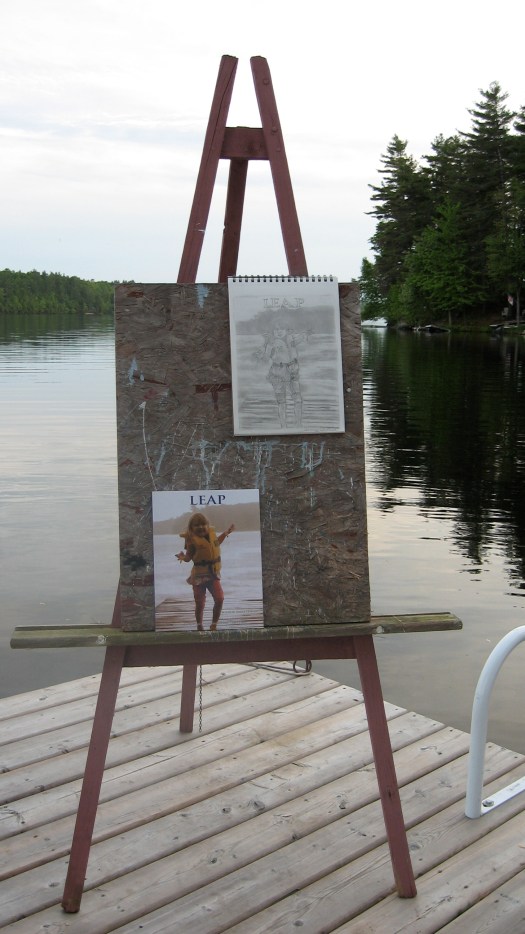
That this should seem such a strong theme in the book is, perhaps, at least partly down to the inclusion of Grace Stewart’s photographs. These, too, by definition, ‘capture’ the moment, their clear, sharp aesthetic providing, not mere illustration as such, but a visual commentary, a heightening of atmosphere, as in the shot of a barn beneath an immense expanse of sky cut only by a single jetstream or the layers of fading blue, like a Rothko painting, in a picture of a lake and landing stage. Photographs and poems don’t always make the happiest of bedfellows, the one making the other too explicit, narrowing down rather than opening up potential meanings, but here the A4 format gives the images plenty of room and they enrich rather than detract from the experience of reading.
All of which, perhaps, is to overlook other crucial aspects of Grace Stewart’s writing: its directness and its humour. As well as the poems which are, as it were, attending to transcendence, there are those which dryly, drolly comment on the foibles of the internet age –in particular, Facebook and Twitter addiction, and, as the title of one piece has it, that ‘New Poetic Genre: The Status Update’. ‘If he were living today/would Shakespeare/use Facebook?’ muses Grace Stewart, postulating such poetic ‘updates’ as ‘Will Shakespeare can see a dagger before him’, while ‘one smart old man’, a sort of virtual Humbert Humbert, transforms himself into the ‘charming and wise’, double-d-cupped ‘Lolita’, and, in the self-explanatory short, ‘140 characters of less’, the whole Tweetocracy collapses into a satirical slogan the marketing department almost certainly won’t be plagiarising: ‘I’m bored, I’m bitter, I’m on Twitter’. On the other hand, too, this more direct, more performative style leads towards other, more serious themes, such as post-9/11 anxiety and the detachment of the almost mythical political world from the one which the rest of us inhabit – ‘one hand’, after all, really can’t ‘hold the weight/of the world.’
Ultimately, in fact, you could say that this collection embodies a similar recognition: poetry, too, can’t hold the weight of the world but it can, as it does in these accomplished but unforced pieces, engage, entertain and enliven. (Tom Phillips, Various Artists)
Leap is available here
Share this! REALLY, it's ok! :) And don't forget to sign up on the landing page to join the HGS BookClub.


 Heather Grace Stewart